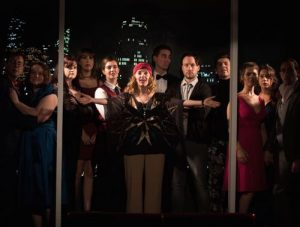
 When Midnight Strikes continues at the Drayton Arms Theatre, London until 12 November.
Star rating: three stars ★ ★ ★ ✩ ✩
In all likelihood, it is one of life’s experiences to be present at a New Year’s Eve party that has been more of an endurance test than a celebration.
The party marked in When Midnight Strikes is given an added frisson in that it heralds the new millennium, so adding an extra spice to the conversation ranging from computers going down to some distant apocalyptic event.
What transpires however is more a domestic drama about a disintegrating marriage of the sort Edward Albee might have penned with songs by Sondheim.
The catalyst for the drama is a written note that reveals to the wife that her husband has been playing hookie with one of the guests at the party.
When Midnight Strikes (music by Charles Miller, book and lyrics by Kevin Hammond) is set in an apartment in New York. Doors open onto a raised balcony with neon-lit railings over-looking illuminated skyscrapers.
At midnight, fireworks light up the indigo sky, raising the suggestion of a happy ending? Well not for Mr and Mrs West, the couple hosting the evening. Solemn opening chords and a mournful cello theme dispel that illusion as the piece unfolds over 20 musical numbers, all of them linked intricately to the book.
In the first of them, ‘Little Miss Perfect’, we meet Jennifer, the proud wife, played by Elizabeth Chadwick, who also doubles as the show’s co-producer alongside fellow cast member Marc Kelly.
It’s a tricky role as she vies for audience sympathy at one moment, relinquishing it the next, while her seemingly patient husband takes the brickbats. Her brassy delivery, even in the concluding title song, doesn’t make for a sympathetic figure.
Her husband, Simon Burr, has that advantage, his performance building to a state of genuine anguish in the finest song of the evening, ‘Like Father Like Son’, where he bemoans his fate as the philandering son of a philanderer.
Other performers who make their mark are Ellie Nunn with her rueful song as an out of work actress, ‘I Never Learned To Type’; Stephanie Lyse as the femme fatale dressed in scarlet, with the blistering ‘What You See’; and, funniest of all, ‘Party Conversation’, a duet for the odd couple, Victoria Waddington and Andrew Truluck (a stock number though it may be, it enlivens Act II).
Marc Kelly, the show’s co-producer and director, gives a touching performance, as well as employing his cast to best advantage in the space available.
The other roles, though ably taken and very well sung, require further attention from the writers to flesh out the characters. As members of the ensemble, their most impressive moment comes at the start of Act II with their a cappella setting of the title song.
The projections and set design by J Mark Pim and Victoria Francis add a handsome visual aspect to the evening that is embellished by Dominic Veall’s poignant cello contribution, roundly applauded, which is a pleasure to hear.
The omission of the authors’ names and biographical detail about them in the programme is unfortunate.
Adrian Edwards
www.thedraytonarmstheatre.co.uk
SHARE THIS POST:


Comments are closed.