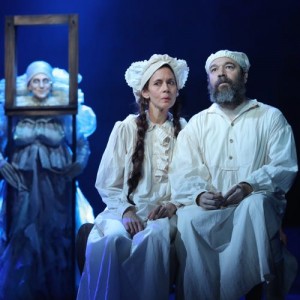
Lori Wilner, Jessica Hecht and Danny Burstein in Fiddler On the Roof at the Broadway Theatre, New York. Picture: Joan Marcus
Fiddler On the Roof continues at the Broadway Theatre, New York.
Star rating: five stars ★ ★ ★ ★ ★
“Because of our traditions, we’ve kept our balance for many, many years,” says the dairyman Tevye at the start of Fiddler On the Roof. Although the musical itself tells how Tevye learns to cope with the breaking of old traditions, there is a good kernel of advice in that line. It’s advice that Bartlett Sher, director of the new Broadway revival of Fiddler, seems to take to heart when it comes to remounting beloved musicals. Sher respects them and builds on their traditions – the music and the emotional pull – that made them beloved in the first place.
This respect is apparent in his still-running staging of The King and I earlier this year and his 2008 mounting of South Pacific. And it makes his Fiddler as engrossing and satisfying a theatrical experience as it ever was. Although there are some distinctive directorial and scenic touches, there’s nothing that’s really going to jar the multitudes of ticket buyers who want to see the Fiddler they know and treasure. With its brilliant book by Joseph Stein, based on stories by Sholom Aleichem, and its rousing and thrillingly integrated score by lyricist Sheldon Harnick and composer Jerry Bock, Fiddler is the kind of work where familiarity breeds only more and more affection.
Sher’s company validates that affection by imbuing the milieu, the village of Anatevka in pre-Revolutionary Russia, with a crackling sense of life, as it whirls around an endearing Tevye embodied by Danny Burstein.
Burstein is a five-time Tony nominee and veteran of 16 Broadway shows, and whether Fiddler pumps up his marquee value to the level it deserves remains to be seen. Nevertheless, he creates a gratifyingly human-scale Tevye: not a boisterous comic or a shtetl superhero, but a hardworking man with a genial playful nature, empathy for his fellow townsfolk, and all-encompassing love for his family, despite his short-lived bursts of temper. This human dimension makes it even more heart-rending, when he is faced with unexpected changes in the world he knows and feels comfortable in. At home, the three eldest of his five daughters are finding husbands on their own without his prior approval and without the time-honoured ministrations of a matchmaker. At the same time, throughout Russia, the tyranny of the government inexplicably mounts.
Still, there is no doubt that Tevye’s spirituality – his conversations with God – is simply part of his DNA. That spirituality registers joyfully in Tevye’s musical numbers: among them, the always spine-tingling ‘Tradition’, the wishful aspirations of ‘If I Were a Rich Man’, and the poignant but funny ‘Do You Love Me?’, in which he questions the romantic inclinations of his wife Golde, a strong Jessica Hecht. Hecht’s Golde is a business-like helpmate, whose shrewishness is tempered by an underlying sweetness of spirit and dedication to her family.
Tevye’s three marrying daughters each emerge as well-drawn individuals: the lovestruck Tzeitel of Alexandra Silber; the spirited Hodel of Samantha Massell, and the studious Chava of Melanie Moore. Their musicality is equally accomplished, in their ‘Matchmaker’ trio and in Massell’s ravishing ‘Far From the Home I Love’.
The daughters’ beaus are equally well enacted. Adam Kantor gives Tzeitel’s long-time love, the meek tailor Motel, a welcome hint of manliness, while the political proclamations of the revolutionary Perchik, who wins the heart of Hodel, carry a genuine altruism in the portrayal of Ben Rappaport. Nick Rehberger makes a convincing nice-guy Russian as Fyedka who in the strongest blow against Tevye’s tradition marries Chava.
Among other prominent roles, Alix Korey expertly delivers the laughs expected from the loquacious matchmaker Yente, and Adam Dannheisser combines the gruffness and good heartedness of the butcher Lazar Wolf, whose bid to marry Tzeitel fails.
Throughout the show, the large orchestra, (nearly two dozen pieces) contributes immeasurably to the show’s vivacity, excitement and emotional strength. The conductor/music director is Ted Sperling, who also wrote new orchestrations. The sets by Michael Yeargan evoke the ‘tumbledown, workaday Anatevka’, as described in one of the songs, and Catherine Zuber’s costumes carry through the mood. The physical production’s most elaborate moments come in the surreal depiction of ‘Tevye’s Dream’, which Tevye concocts to get Golde to agree to Tzeitel’s marriage to Motel.
Unlike other Fiddler revivals, which usually give choreographic credit to the late Jerome Robbins, the director and choreographer of the original 1964 production, the programme for this one simply lists Hofesh Shechter as choreographer. However, the programme also carries a line noting the production is “inspired by the work of Jerome Robbins”. That inspiration is quite evident in Shechter’s work, delivering many of Robbins’ iconic creations, such as the bottle dancers at Tzeitel and Motel’s wedding, and the twirling Russians and the high-stepping Jews who battle it out in the village tavern in the ‘To Life’ number. A mark of Shechter’s work is the super-energetic nature the dance sometimes take on, with the dancers bringing to mind the flailing of religious zealots.
The Sher innovation getting the most attention is the framing device. At the start of a show and in its final moment as well – as the citizens of Anatevka depart for unknown lands under edict of the Czar – Tevye appears in a modern jacket. As he goes into his opening monologue at the start of the show, he takes off the jacket to reveal his dairyman overalls and pulls out a cap to cover his bare head. Sher’s intent is to tie the show to the current global concerns over immigration.
Whether or not this works for you, these are short-lived moments in a show that for the most part excels in bringing a classic work to grand life, with tradition beautifully deep in its soul.
Ron Cohen
Readers may also be interested in:
The Color Purple – Bernard B Jacobs Theatre, New York – Review
SHARE THIS POST:


Comments are closed.