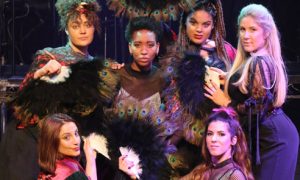
Picture: Josh Bird
Six continues at the Arts Theatre, London until 22 January.
Star rating: five stars ★ ★ ★ ★ ★
It was inevitable, perhaps, that the runaway success of Hamilton on Broadway would inspire a new generation of musical theatre writers. As Lin-Manuel Miranda’s epic musical shows, it is possible to engage with a country’s history using modern musical styles.
Toby Marlow and Lucy Moss may have been inspired by Miranda in their creation of Six, in which Henry VIII’s wives compete to determine which of them has the greatest story.
Certainly several of the songs’ occasional drops into rap rhythms have the same sort of cadence to them. But there’s a sense of fun and comedy that also hints at the influence of CBBC’s award-winning Horrible Histories, the sketch show which has featured musical numbers covering anything from the succession of the Royal line to Rosa Parks and the civil rights movement.
In a scenario that could have been lifted from that TV show, the six wives engage in an X Factor-style competition to decide who is the queen of queens, by dint of having had the toughest time – because what could be more British than a talent show in which the contestants’ sad back story was a determining factor.
And so we get Renée Lamb’s Catherine of Aragon lamenting how she was brought to England as a teen to marry Henry’s brother Arthur, having been betrothed to him at the age of three. Catherine’s feistiness (Thomas Cromwell once declared “If not for her sex, she could have defied all the heroes of history”, a quote that sums up these women’s portrayals) gives way to Christina Modestou’s Anne Boleyn, whose youth and feistiness are manifest in a fun bubblegum pop number, ‘Don’t Lose Your Head’.
Jane Seymour – the “died” in the “divorced, beheaded, died” mnemonic – has a harder time claiming that she was the hardest done by, given that Henry supposedly loved her until her death.
Natalie Paris lends a sensitivity to an Adele-styled ballad, pointing out that his love may have had more to do with both having given him an heir and her early death, before he got bored.
With three queens down, the solo numbers take a brief back seat for an ensemble number suggesting that painter Hans Holbein was commissioned to create a series of portraits of eligible candidates to be wife number 4.
The ‘House of Holbein’ is a mash-up of so many Germanic styles – bouncing from Kurt Weill to Kraftwerk, from Bavarian Oompah to Europop – that it should not work as well as it does.
As with all the numbers, it is a testament to musical director Joe Beighton and musical supervisor George Stiles that the ridiculousness of the premise is so utterly compelling.
It was Holbein’s portrait of Anne of Cleves that secured her Henry’s hand – and rumours that Henry was unimpressed with how she looked in reality forms the driving force for Genesis Lynea’s solo number as Anne.
Whether or not Henry really was the first person to feel misled by his date’s profile pic, it is a great parallel to draw, and helps enliven an already majestic characterisation of Anne as a woman who is happy to live out divorced life as a party girl in her Richmond Palace pad.
Marlow and Moss struggle a little with finding new stuff to find for Henry’s last two wives, with Katherine Howard’s life mirroring elements of several of her predecessors.
Aimie Atkinson still manages to deliver a number which dwells on her exploitation by various men from an early age. It is perhaps the story that could be the hardest to put into a modern setting – the story of a sexual relationship with her music teacher at the age of 13 is a hard one to present as anything other than an issue of abuse.
The storytelling, both through the lyrics and Atkinson’s performance, help to portray Katherine as the victim of predatory men in power, though, turning her story into one that resonates sadly all too well.
Izuka Hoyle’s Catherine Parr is honest that, as the woman who outlived the women’s shared husband, she hardly had the worst time. But Hoyle becomes the galvanising force, bringing the six back together as one, even as they come to appreciate that for all their characters’ feminist desires, we are only interested in them because of their relationship to a man.
A concluding number that imagines life for the women without Henry is perhaps the least successful of the lot, hampered a little by sound problems that plague the Arts Theatre’s amps throughout. But by that stage, there is so much goodwill for this plucky little show that it matters not.
It is perhaps remarkable that this show, directed by Lotte Wakeham, has ascended so rapidly, from a Cambridge University Musical Theatre Society production via the Edinburgh Festival Fringe (where it was nominated for the inaugural Musical Theatre Review Best Musical Award) to an all-too-brief run in the West End. But the sheer quality on show means that its upward trajectory is completely deserved.
Other musicals will come along which, buoyed by Hamilton’s success, attempt to tell historical stories in a contemporary fashion. The challenge they will face is being as joyous, as knowing, as funny and as moving as Six.
Scott Matthewman
SHARE THIS POST:


Comments are closed.