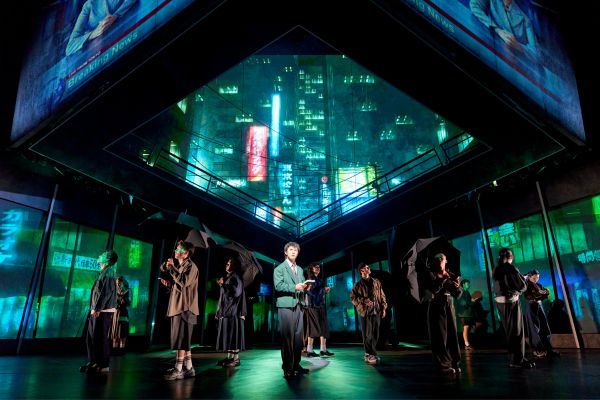
Xander Pang and the cast of Death Note: The Musical at the Barbican Theatre, London. Picture: Manuel Harlan
Death Note: The Musical continues at the Barbican Theatre, London until 12 September 2026.
Star rating: four stars ★ ★ ★ ★ ✩
The Japanese supernatural crime manga series Death Note has been adapted into novels, anime series and live action films before hitting the theatrical stage. This musical, composed by Frank Wildhorn with lyrics by Jack Murphy, started life as a 2015 production in Japan. A reworked version was presented in concert in London in 2023 but now, with further changes, this full-scale production has claim to be a world premiere.
The story revolves around a series of gods, known as shinigami, who hold the power of death over humans. When they write someone’s name in their books, known as Death Notes, that person dies. The shinigami Ryuk (Telly Leung), very much in the mould of a trickster god such as the Norse Loki, deliberately drops his Death Note in the mortal realm, where it is found by Xander Pang’s Light Yagami, a student with a sense for justice. When he discovers that he now has the power to kill anyone by writing their name, Light begins ridding the world of violent criminals who have escaped justice by other means.
The spate of deaths attracts much attention. On the internet, the mysterious killer is nicknamed Kira (a Japanese transliteration of ‘killer’). Pop star Misa (Stephanie Zaharis) becomes obsessed with Kira, thankful to him for exacting vengeance on the man who had, years before, killed her parents. But Light’s actions also attract the attentions of the local police force, led by Paolo Montalban’s detective Soichiro – who, rather inconveniently, happens to be Light’s father.
That’s an awful lot of setup for one musical, and neither Wildhorn and Murphy’s songs nor Ivan Menchell’s book wastes any time. Several of the early songs drop us straight into the worlds of characters and expect us to pick up their personalities and motivations immediately. That’s in keeping with the source material – manga and anime are not media forms that revel in slow reveals – but can initially be jarring. In less assured hands the amount of sheer exposition necessary to immerse us in Light’s world might also be frustrating, but the musical numbers, combined with Fabian Aloise’s choreography, are immediately involving.
The true tensions at the heart of the plot start to emerge when Soichiro hires the mysterious detective, known only as L, to hunt down Kira. L’s reputation is as the world’s greatest, always solving every case with a hit rate that would put Sherlock Holmes to shame. With Light being able to kill anyone whose name he knows, L’s anonymous identity affords some protection. It also places his actual appearance at odds with his reputation – far from being an imposing Holmesian figure, Colin Ryan’s L is a sunken-eyed, wild-haired teenage hacker.
The crime genre thrives on unorthodox detectives, of course, and also is rife with mysteries that are less of the whodunit variety and more of the ‘howcatchem’, from Columbo to Elsbeth. L certainly fits into that mould, although even in the show’s two-hour, 20 minutes running time there’s precious little investigation going on. L makes cognitive leaps that, while handy for pushing the story along, do sometimes appear to emerge from thin air.
But the propulsive nature of Menchell’s book helps to distract from such matters. It’s also helped by the performances. Leung’s Ryuk, while ostensibly not at liberty to assist Light in his killing spree, proves to be a delightfully mischievous companion. And while Pang and Zaharis are superbly competent in their respective roles, it is Ryan’s performance that comes to dominate. His nervy, twitchy style is never less than utterly compelling. A brief section at the top of Act II where the character’s intensity is matched by some comedically kooky weirdness is a brief diversion into humour for his character, but it allows Ryan to add yet more levels to an intricately realised performance.
Ryan and Pang form effective foils for one another, both in terms of character and in musical performance. Some of their cat-and-mouse games may feel a little off – a subplot about L going undercover at Light’s college and the two competing at some form of videogame tennis, complete with comedy avatars, feels particularly divergent from the play’s general mood. But the pace and general quality never lets up.
Similarly, it takes a while for Zaharis’ character to feel integrated with the rest of the story. Her pop star moments are effective, but her relationship with Grace Mouat’s shinigami, Rem, are so disjointed from the rest of the story that when Misa and Light are finally united it feels more of a plot contrivance than organic storytelling.
Mouat’s role also feel subdued for much of the piece. Initially the most aloof and detached of the gods, the depth of her growing feelings for Misa never really feels explained. The character’s treatment means that Mouat doesn’t get to showcase her vocal talent until near the end of Act II — but her rendition of ‘When Love Comes’ is well worth the wait.
Indeed, all of the musical numbers impress. Musical director Katy Richardson’s 10-piece band give an electric, electrifying feel. And while Stephen Whitson’s direction sometimes leans a little too far into the play’s inherent melodrama, Jon Bausor’s set design allows for some impressively smooth scene changes that help the musical flow through its plot-heavy story at a real lick.
Whether fans of the original Death Note will be happy with some of the cuts and changes to fit the story into a two-act musical structure, there is no denying that the result is a taut, compelling tale that is accessible to anyone unfamiliar with the source material. Utilising the Barbican Theatre’s stage to its fullest extent, this is a musical that earns the hype.
Scott Matthewman
SHARE THIS POST:


Comments are closed.