
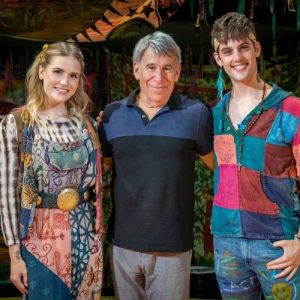
Composer Stephen Schwartz and the cast of Pippin. Pictures: Edward Johnson
When STEPHEN SCHWARTZ was just 26 years old, he had three successful shows running on Broadway simultaneously. Four and a half decades later, with Wicked about to join The Prince of Egypt in reopening after the Covid closures, and Charing Cross Theatre’s psychedelic production of Pippin extending its run to 3 October 2021, the legendary musical theatre composer is about to re-create that feat here in London.
As a long-time fan of Schwartz’s work and as an aspiring musical theatre composer himself, Musical Theatre Review’s Ian Bowkett jumped at the opportunity to chat to him about his shows and his approach to writing music. This interview was conducted on stage at the Charing Cross Theatre, just as the extension to the Pippin run was announced.
Stephen Schwartz: I started on what became Pippin with a friend of mine when I was in college, 50 years ago. I was at a school called Carnegie Mellon, which is a drama school in Pittsburgh, Pennsylvania. There was a club that did an original musical every year and I worked on it the four years I was there. The third year was a show called Pippin, Pippin – I can’t remember anymore why there were two Pippins in the title – but then when I graduated, I continued to develop it and it turned into this Pippin.
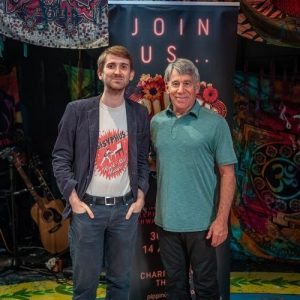
Musical Theatre Review contributor Ian Bowkett and composer Stephen Schwartz
Ian Bowkett: And that was the late 60s, early 70s?
SS: Yes, the Vietnam War; the generation gap; sex, drugs, and rock‘n’roll. A lot of the experiences that Pippin goes through in the show were experiences that I and my friends – my generational comrades – were undergoing at the time. The gentleman who became my co-author on the show, the great Roger O. Hirson, he was about 20 years older, so he was coming at it from a different point of view, and so was Bob Fosse who originally directed it. I think that clash of generations shows up in the show. It’s interesting now to be older than Roger was when he wrote the show, than Bob was when he directed the show, and be looking at Pippin’s journey from that point of view as a parent myself.
IB: The show goes to some quite dark places in its discussion of mental health. I presume people like Bob Fosse would have had a big influence on that, but also you have always been interested in psychology yourself, even studying it academically at one point..?
SS: I did, yeah, that’s my parallel universe career, somewhere in some parallel universe I’m a psychotherapist.
IB: It’s a theme of the show that really resonates at the moment: after two years of lockdown people are thinking more about their mental health.
SS: Also, I think people are rethinking their lives. It’s as if there’s been a time out, and as things are opening back up people are saying, “do I really want to go back to that job that I was in, do I actually want to go back to my life the way it was?” A lot of people are making different choices.
Pippin, as a story, is basically “what do I do with my life?”, and I think that has been reverberating with audiences. Also, witness what is going on outside the theatre today [Extinction Rebellion climate protests] – a new generation is saying, “we’ve got to make some changes in the world because we’re barrelling down the road to disaster”. The idea of a young generation trying to change the world is also deeply embedded in Pippin. All these themes from 50 years ago are coming together. It was startling to me last night seeing the show and feeling, “oh, didn’t I just hear this on the news yesterday?”

IB: Pippin captured this revolution in its music as well. You were writing at a time of a huge creative explosion in rock and folk music, and you were one of the first composers to put that sound into a musical theatre context.
SS: There were a few of us. Andrew Lloyd Webber of course – who’s a contemporary of mine – and my good friend and sometimes collaborator, Alan Menken. The three of us came up at more or less the same time and we were combining a tradition of musical theatre lyrics and storytelling with music that we were listening to on the radio.
IB: Who were those pop music influences at the time?
SS: I had a whole bunch of singer-songwriters and pop groups that I was listening to. When I was writing Pippin, there were the big singer/songwriters, Joni Mitchell; Laura Nyro; Carole King; James Taylor; Elton John; and then the Motown Sound was very influential on me; obviously The Beatles; The Beach Boys; groups like Jefferson Airplane. It all got mushed in with my love for and desire to work in musical theatre. It was like all those sounds meets Rodgers and Hammerstein.
IB: I suppose that’s what you do as a composer, isn’t it? You combine influences.
SS: It’s so born out of what we heard that we loved that we wanted to bring out in our own way. You mush it together and it becomes your own style.
IB: How is that 60s-70s score sounding in this new production? I can see some nice guitars over there in the corner…
SS: It’s two live musicians and then, because of the technology that one has at one’s disposal today, there are some samples and tracks that get added in. It’s actually quite a full sound, but it’s a very pop sound obviously. It is keyboard and guitar based so it is evocative of the time in which the show is written, which is the early 70s. You know, nobody’s rapping, let’s just put it that way. No hip-hop in this one, but I think it still sounds quite fresh.
IB: With all the productions over the years, there have been many different versions of Pippin, in a way that we haven’t seen yet with Wicked, for example. How much input do you get into these changes, and what is it like as a composer to see your work evolve?
SS: Well, people can’t just put on the show and rewrite it for themselves without at least asking permission, but it is very exciting. It’s what I love about live theatre: it’s alive. A show can be reinterpreted, reinvented each time it gets done. The director and the company all bring their own things to it.
Some shows do have more flexibility than others. I have a few shows – Godspell is another one – which really can be strongly reinvented each time they’re done. For me, it’s exciting and interesting because I don’t have to see the same thing over and over again. Actually, I’m soon heading to Hamburg, Germany to see the first big non-replicated production of Wicked. The material itself has not been revised in terms of the book, music and lyrics – though of course it’s in German – but it’s an entirely different production and the music also has been reapproached in terms of the arrangements. I’m excited to see what they’ve come up.
IB: I will have to make a trip there! Like most musical theatre fans, I’m sure I’ve seen Wicked so many times I could watch it in German and not miss anything.
SS: I’ve seen some drawings and models of the set and costumes, it’s completely different, so interesting.
IB: And I suppose that eternally-one-year-away Wicked film will give you another opportunity to revisit that show.
SS: I hope it truly is one year away from at least going into production. There are some hints that’s actually going to be true now. It will be completely re-examined. We want to make a movie and not a filmed version of a staged show. It’s not a live capture, so my co-writer Winnie Holzman and director Jon M. Chu and myself are really thinking about how we want to tell our story as a movie. There are things you couldn’t do on stage, and there are things that you can do very successfully on stage that don’t work so well in the movies, so we’re really having a rethink about it.
IB: I suppose with a show that popular you want to get it exactly right?
SS: I mean, we always want to get it exactly right and you never do, so it’s how close can you get to your aspirations.
IB: You have worked on a lot of animated movies before, was there ever a discussion about making Wicked anything other than a live action movie?
SS: Well, you could make an animated feature of it I guess, but I think it lends itself to live action: actual flesh and blood actors, not CGI or drawings. There are subtleties and nuances of performance and emotion that you just can’t do in animation. It was interesting taking Prince of Egypt as an animated movie, which is a movie I’m quite proud of, but we were able to do so much more with live actors when we did it for the current production.
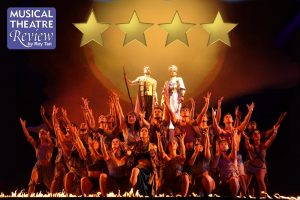
The Prince of Egypt. Picture: Roy Tan
IB: That production is such a grand, visually impressive stage show.
SS: Thank you, I just think it’s so beautiful. My son Scott Schwartz directed it. He’s one of my favourite directors, and I think he did a beautiful job. The design and the lighting are just mind-blowing. It’s so beautiful.
IB: I’ve seen a lot of big shows in the Dominion – it’s a huge theatre – but Prince of Egypt really fills every inch of that space. And hopefully more people will get to see it now that it has reopened – Covid shut it down so early!
SS: Thank you, I hope that that will turn out to be the case now that we’re back. So far, we’ve been doing well in terms of people coming to see it and we hope that remains the case and we don’t get shut down by Covid again!
IB: Well, Prince of Egypt began life as a film, and Wicked will be a film hopefully very soon, but with Pippin being so meta-theatrical, I can’t imagine a film of that has ever been discussed?
SS: No, that’s not true. We have talked from time to time, people have come to me about the possibility of a film version. I can’t really talk about it because it’s so formative right now. I don’t know that will happen but there is a director and writer team who have come to me with a – I think – a really clever notion about how to make it.
Instead of meta-theatrical, it would be meta-cinematic. I don’t know whether that will come to pass, but your point is well taken. I think it’s a harder jump to do Pippin as a successful movie than to do Wicked as a successful movie, because Oz already exists in a cinematic world. This world of Pippin, how do you translate that? How do you make something that’s about putting on a show about making a movie instead, and still tell that story? I know I’m being mysterious because it’s so formative, but I do think the two people who came to me have a really good cinematic idea and we’ll see if somebody wants to do it.
IB: That meta-theatricality is one of the things that makes the Pippin stage show so perfect for this moment in time: audiences are getting a uniquely theatrical experience after all these months of lockdown.
SS: It’s one of the things I love about the show, that the show doesn’t make sense without the audience. That’s true of all live theatre of course, but this is so much about this troupe of performers doing something for the audience in complicity with the audience. As you say, it has that sort of meta, post-modern quality. I think if you’re going to go back to live theatre, it’s nice to be seeing something where you’re not just sitting back as a spectator.
IB: And it’s doubly joyous in this venue to have the audience surrounding the stage…
SS: I love the whole set up of this theatre, I think it works extremely well for this particular show. Frankly, I’d love all my shows to be done for the smallest possible house because then it has such intimacy, but it’s always a balancing act between actually having enough seats that you can afford to run the show and maintaining a degree of intimacy. With Prince of Egypt, [director] Scott Schwartz and everyone on the production really strove in terms of the design and the way it’s staged to make it feel as intimate as possible, even though we’re in a 2,000 seat house in the Dominion Theatre.
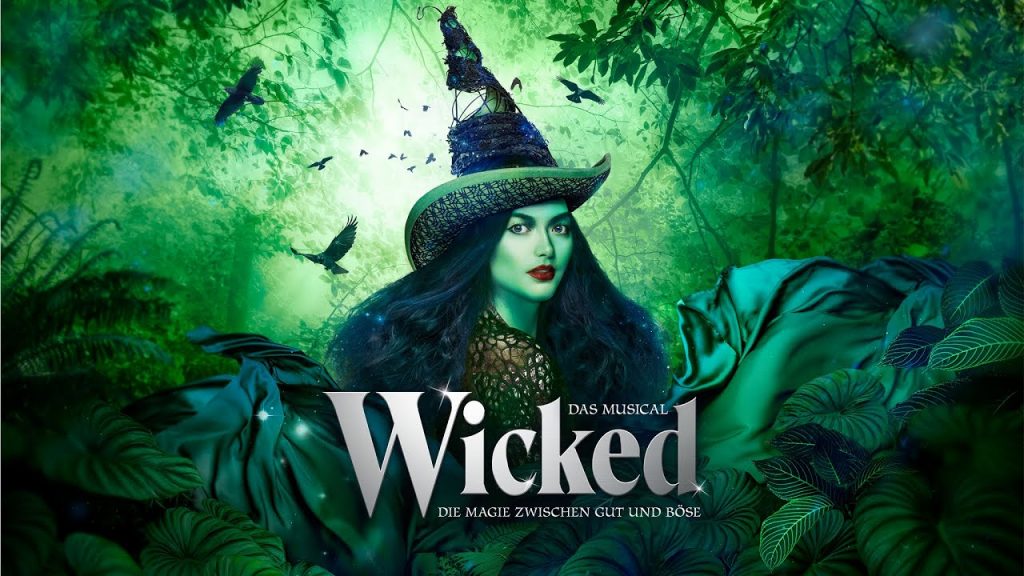
IB: Is this new Hamburg Wicked production in a smaller theatre?
SS: It is a slightly smaller theatre, yeah. I think the rationale behind doing a big non-replicated production, is to have a version of the show that can play in places where they just couldn’t house the original production. There are countries that have wanted to do Wicked, but they didn’t have a theatre that could encompass the original production.
IB: Fantastic, and one day we might even see school performances and community theatre productions?
SS: Yes, I can’t wait for that. There’s a thing called Wicked Junior that’s not fully available yet, but I’ve seen some test productions – the little one-hour version done in schools as they’ve tested it. There’s something so great about watching middle school or high school kids doing Wicked.
IB: I can’t imagine how great it would be to have kids all around the world performing something you’ve written.
SS: Exactly, that’s so gratifying when you have something that then can go to the next generation or, in my case, probably the next two generations and be given new life.
 IB: Speaking of helping the new generations, when I first started out writing musical theatre myself, I stumbled across your website (www.stephenschwartz.com) where you have huge pdf files of Q&As about composing and musical theatre in general. I learned so much from them, so thank you!
SS: Oh, thank you. What kind of music do you write?
[At this point I gestured to my t-shirt, because I am shameless enough to wear my own merch to interview a musical theatre legend like Stephen Schwartz.]
IB: This new show [Sisyphus: A Rock ‘n’ Roll Musical, 6-9 October, Canal Café Theatre] is quite rock influenced, but I am trying to weave in that classic musical theatre style too, so I have been reading lots from composers such as yourself.
SS: I think that’s useful: listening to things you like and saying, why do I like this and how can I use that technique or gimmick or whatever you want to call it in my own style. That’s basically what I did: you put together what you like and it comes out as your style.
IB: You are very generous with advice and support for new composers. You’re clearly not intimated by the next generation of people coming up. Are there any particular new composers you really like at the moment?
SS: Lots and lots and lots. You know, they’re not mysterious names: Benj Pasek and Justin Paul, who are friends of mine, I’ve known since they were at university, and I love Dear Evan Hansen. It goes without saying: Lin-Manuel’s work. Lin-Manuel Miranda is also a friend of mine.
Every year there is some new, really interesting work. I haven’t seen Six yet because just as I was about to see it, it shut down, but people I know who have seen it have been very enthusiastic. I’ve met those writers [Toby Marlow and Lucy Moss] and they’re young and smart and talented. I started to do musical theatre because I liked going to see musical theatre. The nice thing is, it’s not like sports. It’s not like only one person can hoist the Wimbledon trophy. There is room for more than one successful show and so I don’t feel at all threatened by other writers who have success. It gives me some things to see that I enjoy seeing.
IB: That makes sense – you write theatre because you love theatre.
SS: Oh, I mostly want to see things that I haven’t written. And then – you know as a writer yourself – one is constantly inspired by what you see, someone doing something that you have never thought of, and you say, oh that’s such a cool idea. Could I sort of take that idea and use it in a different way for something I’m doing? That’s the nice thing about this business, we’re all inspiring each other.
IB: Do you have any examples of that? Where you’ve thought, I love this moment, how can I make something like this?
SS: Constantly, yes. I mean, over and over again. I mentioned Dear Evan Hansen and I loved the way they used media and the idea of social media. It was inappropriate for Prince of Egypt or something like that, but I loved the way they incorporated social media and the idea of this being a social media generation but made it theatrical. I’ve seen several things that have used media in ways that complement the theatricality as opposed to overwhelming it and I think we’ll see more and more of that. It’s giving me some ideas.
IB: What do you do with your ideas? If you’re between projects and you have musical or lyrical ideas pop into your head – do you have a desk drawer full of notes?
SS: Not really, I have to tell you at this age and at this stage of my career, I tend to write on assignment, so to speak, whether they’re assignments from Disney or Dreamworks, or they’re a show that I’m working on myself with collaborators. There aren’t really ideas floating around there for me, it’s much more that I’m thinking about something for this character or this story.
IB: That’s probably the way to do it: keep busy with assignments rather than recording a thousand voice notes you may never listen to again as I tend to…
SS: Well, you’d be surprised how those things come back. There are a couple of tunes in Wicked that I had in my head years ago, and suddenly I thought wait, that thing I was working on 20 years ago, I can actually use that here in Wicked if I change this or that about it. The opening theme, that then becomes the song ‘As Long As You’re Mine’, that’s actually based on a song that I wrote in the 70s and wasn’t satisfied with how the lyrics came together. I always liked the basic music and the tune and then when I was starting work on Wicked it came back to me and I thought, oh I could actually adjust that and have it work for the show. That’s just one example. So, you’re not wasting time by doing that, that’s what I’m telling you.
IB: I’ve heard in another interview that a technique you use to compose in a specific style is immersing yourself in inspirational music before you sit down to write. I think with The Baker’s Wife, for example, it was lots of French music?
SS: Yes, I played a few of the French composers on piano, Debussy and Ravel and Satie. I was listening to a lot of French music, playing it and getting it in my memory, in my fingers. Then when I sat down to write I tried not to think of it consciously, but it was there.
One of the projects that I’m thinking about working on now – I don’t know if it will happen or not – but it’s quite firmly set in Spain, so I will be doing the same thing with Spanish music, certain Spanish composers and songs. But I still remember working on The Baker’s Wife and suddenly I’d be hitting a chord that I would not normally have done if I hadn’t been playing Debussy for months, and I was like, oh where did that come from? It really sounds French!
IB: Was that a technique you developed over the years, or have you always done that since the beginning? Since Pippin?
SS: It’s interesting, that’s something my friend and collaborator Alan Menken is very conscious of and made me realise that I did it but not as consciously. It’s developing what he calls the palette, the musical palette, for each project. I think he’s extremely skilled at it. You hear the music for Aladdin, you’re clearly in a different world than Beauty and the Beast, than Hunchback of Notre Dame etc. Stylistically, what is the musical world of this piece? Really you shouldn’t be able to take a song from one show and just plop it into another show and not notice. Of course, sometimes you can, but really if you do a good job, each show should be its own musical world.
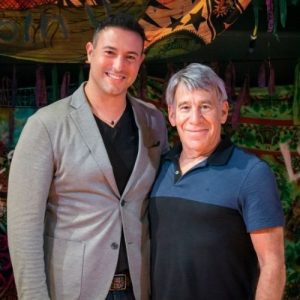
Theatre Channel producer Adam Blanshay and Stephen Schwartz
IB: I thought you did that really well with The Prince of Egypt, how you incorporated Eastern scales and the music all felt unique to that show.
SS: Thank you, we worked really hard on that in terms of using authentic instruments of the region in the orchestration. I was working in a slightly different scale than the traditional Western scale a lot of the time.
IB: Before we wrap up, I hear you are also about to be featured on The Theatre Channel?
SS: Yes, I’m very flattered to be the first living composer who has been featured in one of The Theatre Channel episodes. It’s a new creation, these Theatre Channel presentations. Adam Blanshay – who produces them – asked me if I wanted to be the subject of one of them, and he sent me the ones that had been done. I was really impressed with them.
That’s really what brought me over here. Of course, I came to see Pippin and I’m going to go check in on The Prince of Egypt also, but I am really here to record some interstitial comments to set up the songs. I’m actually going to perform one of them too: I’m going to do ‘When You Believe’ with the group, kind of live. I’m very flattered and excited about it. I’ve seen one of the songs that’s going to be on there and I was blown away by how beautifully it was shot and edited. I hope the whole episode is that good. I will be proud of it.
IB: Hopefully you will be the first of many composers on The Theatre Channel.
SS: I know there’s one coming up after me. I don’t know what I’m allowed to say, but they have spilled the beans. Let’s just say a composer who is very well-known to British and worldwide audiences is coming up next…
IB: I’ll have to have a chat when we stop recording.
SS: Yeah!
- You can still catch Pippin live at London’s Charing CrossTheatre until 3 October 2021
- Episode Eight – Stephen Schwartz from The Theatre Channel is available to watch from 17 September 2021


Comments are closed.