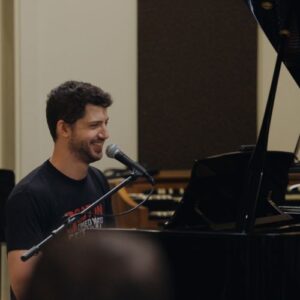
 DYLAN MARCAURELE is the creator and star of Pop Off, Michelangelo!, playing at London’s Underbelly Boulevard Soho from 17 May to 13 July 2025.
Known for his boundary-pushing work that celebrates queer themes, Dylan’s creative vision has garnered critical acclaim for both his theatrical performances and his original productions. Pop Off, Michelangelo!, already a huge hit at the Edinburgh Festival Fringe, is a queer-themed musical comedy which celebrates LGBTQ+ identity through camp, artistry and over-the-top drama.
Set in Renaissance Italy, where Michelangelo and Leonardo da Vinci compete to create the most legendary religious masterpieces, the musical features electropop anthems and offers ‘a wildly inaccurate version of history, showcasing art, ambition and divine chaos’.
Musical Theatre Review editor Lisa Martland, reviewing the show at the Edinburgh Festival Fringe last year, wrote: “What NYC-based Dylan MarcAurele (book, music and lyrics) does so brilliantly in Pop Off, Michelangelo! is pack the script to the brim with camp, contemporary references (Cher, Drag Race, Legally Blonde and more), pretty fruity lyrics, witty one-liners and a nod to historical context, but at the same time still presents likeable characters who the audience roots for.”
Here Dylan MarcAurele continues Musical Theatre Review’s interview series: Five Questions With…
What was the development process like for Pop Off, Michelangelo! – from initial concept via Edinburgh to securing a London run?
In January of 2024, I had a concept for a musical about Michelangelo and Leonardo da Vinci as best friends, and I was invited to work on it at a programme called the Johnny Mercer Foundation Writers Grove at Goodspeed Musicals in the US. I had so much fun writing songs there and getting feedback.
One of the programme leaders, Blair Russell, said he’d take it to the Edinburgh Festival Fringe if I could finish the show by March. (In retrospect, it was helpful to have such a quick deadline because it prevented me from questioning whether the whole show was too ridiculous.) The Edinburgh run was a big success, which led to a quick two-night stint at The Other Palace last November, and now a full run, and I’ve been allowed to add back some material we initially had to cut for the Fringe.
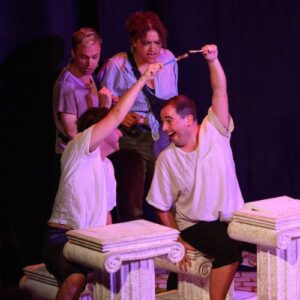
Picture: Steve Ullathorne
How did you approach integrating period-specific references with modern musical styles and comedic elements?
I consume way too much reality television, TikTok, 2010s pop music and YouTube compilations of hilarious drag entertainers – so it’s probably no surprise when those influences sneak into my work. But I also think the nice thing about showing history through a modern lens is that it allows us to see the main characters not just as Michelangelo and Leonardo, but as Mike and Leo – two actual human beings who had the same insecurities and vulnerabilities we all do today.
The show is described as a love letter to queer culture, making it a timely and important show for the LGBTQ+ community. Celebrating queer themes and culture is obviously extremely important to you, can you elaborate on that?
Pop Off is kind of an indictment of the way that the Catholic church and other institutions force queer people to hate themselves and seek external validation. I’m sure a lot of queer people relate to that. But also, we’re in a fun place right now culturally where ‘queer’ and ‘mainstream’ pop culture aren’t so far apart, so I’m excited to have written something that dives into that headfirst.
Collaboration is key in new musicals – how did your team, including director Joe McNeice and the performers, influence the final tone of the production?
Everybody has been so enthusiastic about making the production match the tone that I imagined. And even more exciting is when the path to get there was different from how I imagined: for example, Joe encouraged the cast to use their natural accents (I wrote it as an ‘American’ show) – which has invariably led to funnier, better and more honest performances. The result is this fun hybrid of American chick flick energy, British camp and Renaissance Italian history – it shouldn’t work but it does.
There has been a flurry of new British musicals which have enjoyed success recently, do you feel there is a bit of renaissance for original writing or is it just as tough as it’s always been?
As an American, all I can say is that it seems British culture is more supportive of original theatre writing from up-and-coming writers. I think New York puts so much pressure on high production values and theatre being a grand once-a-year event for audience members, as opposed to theatre being a cheaper but more frequent social norm. I think that makes London a great place to develop new work, and I’m sure that trend will continue.
Readers may also be interested in:
Pop Off, Michelangelo! – Edinburgh Festival Fringe – Review
SHARE THIS POST:


Comments are closed.