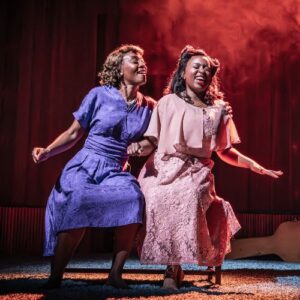
Beverley Knight and Ntombizodwa Ndlovu in Marie & Rosetta at the Rose Theatre, Kingston and Touring. Picture: Marc Brenner
Marie & Rosetta continues at the Rose Theatre, Kingston until 24 May 2025. ETT’s production also plays the Grand Theatre, Wolverhampton from 27-31 May and Chichester Festival Theatre from 25 June-26 July 2025.
Star rating: four stars ★ ★ ★ ★ ✩
The place of Sister Rosetta Tharpe in the pantheon of pop as the Godmother of Rock ‘n’ Roll has been largely unrecognised and not many of the first-night audience at this UK premiere of George Brant’s 2016 play-with-music would have been aware how much Chuck Berry, Little Richard, Jerry Lee Lewis and even Elvis himself owed to this pioneer who made gospel singing sexy in the swinging late 1940s.
Indeed, Berry said his act was “one long Sister Rosetta Tharpe impersonation”, yet even the Rose’s artistic director Christopher Haydon admits that until he read the play nine years ago, he hadn’t a clue who she was, and when I spoke to audience members afterwards just one said she knew of Tharpe – only through her parents talking about her. The rest had come to see the luminous Beverley Knight, Olivier Award-winning West End star and national treasure. To have her name above the title should guarantee full houses for the rest of the three-week Rose run and subsequent Wolverhampton and Chichester exposure and they won’t be disappointed.
Wonderful though she is, they will go away singing the praises of 21-year-old newcomer Ntombizodwa Ndlovu every bit as much. As Rosetta’s originally prim, Bible-loving protege Marie Knight, she almost takes the roof off with her opening number, the gospel hymn ‘Were You There’, so much so that various couples turned to each other in amazement as if to say “What have we just heard?” A star is born.
Tharpe, already in the big time but shunned by parts of the church-going community for singing gospel in nightclubs alongside scantily-clad showgirls, sensed the girl she spotted singing in a quartet had star potential and if the real Marie had as much voice as the thrilling Ndlovu, she was indeed special. It was worth the ticket for that magic moment alone – with first impressions being confirmed in her other solos and in joyous duets ‘Up Above My Head’, ‘Didn’t It Rain’, ‘This Train’ and ‘I Want a Tall Skinny Papa’.
Such a generous performer, Knight herself is pure class, teaching her younger partner how to wiggle her hips and make the most of her assets. “You gotta learn to have fun,” Rosetta tells Marie. “If we were meant to have fun, why ain’t there any jokes in the Bible?” counters the younger woman. If only the rest of the sometimes-plodding script was as amusing. Sadly, in perfecting her Deep South accent (and it was spot-on), Knight lost some clarity and only those sharp ears familiar with Mississippi patois caught the punchlines. While they were laughing, some just didn’t get it.
As the play is written, we have to imagine Sister Rosetta playing her trademark electric guitar (an instrument regarded before she came along as a ‘male’ preserve), but musical director Shirley Tetteh’s guitar backing from one wing of the stage (pianist Liam Godwin is beavering away on the other wing) is of the highest order.
The show’s title, putting Marie’s name first, underlines how unstinting Sister Rosetta was in promoting her new friend at a time when Black female artists had to be exceptional to break through racist barriers and male prejudice, required to perform in warehouses and barns and dossing down overnight in a funeral parlour – that’s where this story begins on Lily Arnold’s intimate set – in the segregated Deep South.
The couple made great music together, putting fame above family, Rosetta freeing herself from a preacher husband who wasn’t averse to slapping her down, Marie sacrificing years with her young children (later killed with her mother in a fire) to go on the road with her senior partner. The close relationship that broke the conventions of the time is not touched upon but it was Marie, by then a big solo star, who came back, in a moving farewell scene, to help arrange the half-forgotten Rosetta’s funeral in 1973.
In a show that’s easy to love because of its two outstanding performers, director Monique Touko even has them mixing with the audience to ramp up the almost cabaret-style atmosphere of this 100-minute no-interval two-hander. To celebrate a legend who deserves to be remembered for broadening the boundaries of what Black women entertainers could achieve even in the toughest of times is admirable and while the play itself, with several passages of uninspiring dialogue, is no more than passable, the music – the songs, the band, the voices – makes Marie & Rosetta well worth a visit.
Jeremy Chapman
SHARE THIS POST:



Comments are closed.