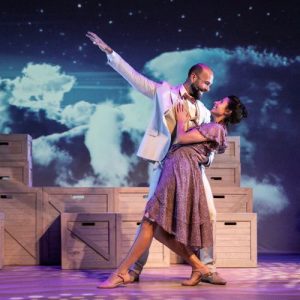
Wade McCollum and Alyssa Martyn in It Happened in Key West at the Charing Cross Theatre, London. Picture: Darren Bell
It Happened in Key West continues at the Charing Cross Theatre, London until 18 August 2008.
Star rating: two stars ★ ★ ✩ ✩ ✩
One can see why the macabre tale of Carl Tanzler, and the true story of his obsession with a young Cuban woman that continued long after her death, might have seemed to be a viable basis for a Gothic comedy romance. Unfortunately, this tale of a genuine corpse bride is a stiff.
In 1930s America Tanzler, a mysterious German then calling himself Count Carl von Cosel, is appointed as a radiographer at a hospital on the Florida island of Key West. There, he meets a young woman, Elena, who his X-ray machine determines is dying from tuberculosis. But von Cosel becomes convinced that Elena is the love of his life, and will not let pesky things like her husband or her death prevent them being together.
It is all fairly preposterous and, were it not based on reality, the book (jointly credited to Jill Santoriello, Jason Huza and Jeremiah James) would be quickly dismissed. As it is, it decides from early on that Carl is a tragic romantic hero, even as he is portrayed as a deluded fop by Wade McCollum.
The problems with the play are evident from the first scene: set just as Carl is about to face trial before his story is told in flashback, the dialogue veers between macabre tension and what appears to be an attempt at hilarious comedy – but, thanks to the flat direction of Marc Robin, fails at either.
And that indecisiveness continues throughout. Act I is presented as a straightforward romance, albeit between a bumbling sex pest and a none-too-bright woman who the book affords no agency of her own. Alyssa Martyn makes Elena a warm and engaging young woman, to be sure, but there is so little reason for the audience to root for the mismatched couple that all the sweeping ballads and Spanish guitars in the world can’t help.
And musically, while the songs (with music by Santoriello, lyrics by Santoriello and Huza) evoke the spirit of an island infused with the culture of its Cuban immigrant community, it is really only Robert Felstein’s accomplished orchestrations, and the performances from the ensemble elicited by musical director Andrew Hopkins, which rescue them.
It is only some time after Elena has died that the musical begins to revive. Act II sees Carl, having disinterred the corpse of his beloved, attempt to live a romantic life with her even as he patches up her rotting cadaver. It is here where the show briefly finds the level at which it is best able to pitch – a black comedy in which Carl’s behaviour intrigues the residents of Key West, who become eager to know who this new, heavily veiled and immobile woman in his life is.
The numbers ‘Everything’s Right With the World’ and ‘Elena from Town’ (in which, after discovering that Carl has been living with a dead body for some years, the townsfolk smell some much-needed tourist dollars) possess the level of knowing absurdity that this musical needs throughout. But that fades all too quickly – as, indeed, does a ludicrous subplot in which Carl obsesses about using the lightning of an oncoming storm to permanently reanimate his love. The cod Frankenstein allusions are swiftly dropped, thank goodness, but such meanderings do not suggest a book that knows what it wants to do with its characters.
The overblown, saccharine romanticism with which Santoriello, Huza and James become overly obsessed might fare better if it emerged from within the confines of the bizarre story, rather than romance and comedy constantly fighting against one another.
As it is, a final monologue from Johan Munir (as Elena’s brother-in-law, Mario) makes a valid point about how, in grief, we often behave as if our departed loved ones were still with us – but, criminally for a musical, what could be a heartfelt, redemptive musical number is passed over in favour of more time with the by now pathetic figure of Carl.
Perhaps the best thing about It Happened in Key West is that it provides its own metaphor: obsessively patched up by people who should know better, this is a work that, if we’re being honest, is dead on arrival.
Scott Matthewman
Readers may also be interested in:
Interview – Jeremiah James on the inspiration behind writing It Happened in Key West
SHARE THIS POST:


Comments are closed.