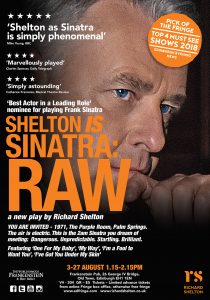
 RICHARD SHELTON knew from a young age that he had a strong connection to Frank Sinatra and over the years it seems that the world was pushing them together. Now he has written and stars in Sinatra Raw in Edinburgh but the show will transport audiences to The Purple Room in Palm Springs in 1971 as Ol’ Blue Eyes prepares for his last pre-retirement gig.
Shelton, is perhaps best recognised for his ‘Best Actor in a Leading Role’ nominated portrayal of Sinatra in Rat Pack Confidential on the London stage.
Currently resident in LA, he isknown to American TV audiences as Arnaud in Jane the Virgin and Mr Benson in House of Lies. In the UK, Shelton is known for his two-year stint playing the charmingly murderous Dr Adam Forsythe in Emmerdale. He was nominated ‘Best Supporting Actor’ for his role as Detective Forbes in both the British and Chicago Horror Movie Awards for in the film Do Not Disturb.
As a singer, Shelton recorded his swing style influenced albums Top Cat at London’s Abbey Road and Richard Shelton at Capitol Studios in LA. He has performed for British and European royalty, at the world famous Ronnie Scott’s Jazz Club, Catalina Jazz Club, Vibrato and Vitello’s Jazz in LA, with the Royal Philharmonic Orchestra, the BBC Concert Orchestra, in the movie I Capture the Castle and has numerous international TV appearances.
Here Richard Shelton is in conversation with Musical Theatre Review’s Tal Fox.
What are your personal memories of Frank Sinatra growing up?
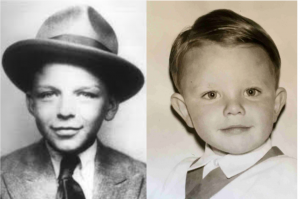
I remember looking through a magazine as a young kid and there was a photograph of Frank Sinatra as a young boy and I said to my mother: “Who is this man Frank Sinatra because it could be me,” and she skeptically looked and said: “Oh my god, it could!” So even as a tiny boy I was aware, I could have been about six years old when this happened, I was aware of this man and the similarities.
When I was about 14, my dad bought the My Way album and it was a cassette that used to clunk in and just intuitively, instinctively, I knew the shape and form of the songs, his voice, his lyricism, and when I opened my mouth to sing it almost came out fully formed, it was a strange experience. So he’s always been present in my life, I also enjoyed his music in my late teens and early twenties. I wasn’t listening only to Frank Sinatra but I was always aware.
You’ve had quite a few bizarre connections to Sinatra, can you talk us through some of them?
It’s really weird. When I performed in Rat Pack Confidential we discovered that I have the exact same dimensions as Frank Sinatra. It was borne out when I firstly went to live in America and I put my hands and feet into his imprints on the Hollywood Walk of Fame. Not only did they fit identically, but they were made on my birthday, 20 July, which was really freaky.
Then, because I’d recorded an album at Capitol Studios in LA, I was invited to an industry party. I just happened to talk to this TV producer who told me that she was working on a reality television show and they had just come across Frank Sinatra’s tuxedo and they were looking for a home for it. I said that I had always dreamed of touching something that belonged to Sinatra. I went and tried it on and it fit like a glove. I was on the Alan Titchmarsh show and the fellow guest was Roger Moore. He looked the suit up and down and asked me to show him the jacket, which I did and he said: “Ah yes, that’s Frank’s. Frank Sinatra called me and said ‘Roger, where’d you get your tuxedo made? I want one’.” So that was an extraordinary experience.
There were also more esoteric things like I was one of the last people inside his last home from which they took him to die, through fluke. I happened to drive past as they had just started to demolish it in Beverly Hills and I got to look around. When I was researching this play I’m doing, I happened to turn on the radio and it was BBC Radio 2. At that moment they just happened to be doing a show about the In the Wee Small Hours album. I’ve performed with his musicians, I’ve recorded in his studio, there’s a huge list that goes on and on.
 How was it playing him in Rat Packand being nominated for best actor in a leading role?
The thing is with that man, he is such a phenomenal presence, it’s not about me, it’s simply about challenging and evoking him, trying to bring him to life and trying to really get behind what motivated him. What went on behind those blue eyes and that mercurial dangerous temperament that made the music and the man so extraordinary. So to have been nominated with those complexities involved, it was a thrill. The thrill is doing the job anyway but to get that recognition is phenomenal.
How did you come up with the idea for this show?
I was performing in Palm Springs and The Purple Lounge and the guy who runs it told me a tale about how Frank Sinatra had stood on this stage at this tiny supper club in Palm Springs and performed ‘In the Wee Small Hours of the Morning’. That was a very dark period of his life because he’d split from Ava Gardner and he was morose.This guy then explained that it was the birthplace of the Rat Pack and I said: “No, that was Vegas.” He said, in this room, when Sinatra was singing from this album, it was all so dark and depressing, Dean Martin was in the audience and he shouted out: ‘For god’s sake, lighten up, pally’ and Sinatra said something back and the room relaxed, it was the actual beginning of that act.
It just sparked something for me and I just thought this is a way to examine how Frank Sinatra must have felt when he got into his mid-fifties and decided to retire. What’s it like for an icon to face their own mortality, what’s it like for someone like Frank Sinatra to be in the 1970s and see the world changing, hate rock‘n’roll, how does that impact his psyche? So that’s what the play is about.
What is the set-up of the show?
Very simply it’s a cabaret performance. I’ve set it up so it’s in advance of Sinatra’s actual retirement concert in 1971 in LA and I’ve imagined that he’s gathered a group of friends in Palm Springs, around the piano with a drink and smoking a cigarette, chatting and reminiscing. It starts with that very laidback intimate vibe in the room in which he played but then of course as he drinks, he reminisces more and he starts to, in his own mind, answer questions that have been raised and levelled against him, questions from the press and the mob allegation and his womanising, his drinking and all this comes up through both dialogue and song.
 How do you pick what songs to include?
The dialogue drives the songs, the songs don’t drive the dialogue, it’s a drama. It’s so easy to do an hour or two hours or ten hours of amazing Frank Sinatra music but this isn’t a crowd-pleaser jukebox show, this is far more involved in the man and the Frank Sinatra everybody dreams of meeting at 2am in a bar, drunk, on the edge, a little dangerous.
They’re songs that start off very upbeat but then as he talks and he remembers the great love of his life, Ava Gardner, he spirals into ‘I’m a Fool To Want You’ and ‘My Foolish Heart’. It’s not giving too much away to say that at the end of the drama there’s a great redemption in the song ‘My Way’. I hope that by the end of the show, it explains those lyrics. I’ve put in ‘That’s Life’ because there’s a wonderful lyric in there, “I’ve been a puppet, a pauper, a pirate, a poet/A pawn and a king/I’ve been up and down and over and out…”
He lived all of those things and that’s why the song is a celebration and that’s why when it gets to ‘My Way’ it’s a redemption for that life.
Is it intimidating to create a story for such a huge icon?
Yes, but I don’t think about that. I don’t do it or not do it because it’s daunting, I do it because I’m driven to do it and it’s a passion and it’s a story I have to tell. It’s an ability I have and I want to tell it as best as I can and as honestly as I can and that means not dressing it up, that means not mimicking or imitating, that’s a wholly different experience. This is about truth and that’s what’s interesting. The truth isn’t always pretty but the truth is brilliant when you tie it all together, especially with someone who is interesting.
Have you ever met any of the Sinatras?
Yes, I met his son, I met both of his daughters very briefly, and I’ve met all of his living bandmates, I’ve worked with them. I have met them but very briefly, I didn’t dwell and linger and chit chat but we met and it was a thrill, it was great.
 What is your favourite Sinatra song?
That’s very easy, my favourite is ‘In the Wee Small Hours of the Morning’ because it’s so simple and when he recorded it, allegedly, he had a life size photograph of Ava Gardner in the studio with him and it was after they split up. I don’t know if that’s true or not but that’s what I want to believe and like believing. When you consider his heart was broken and he was broken by the end of that love affair, he attempted suicide, when you consider that and you listen to the words and you hear that performance, it’s breathtaking.
Why did you decide to take the show to Edinburgh?
It’s a great place to open, it’s a great festival and I love it and I love all that energy. I’m interested to take this as a first showcase to show the world, this is the etymology of this project. I would like it to develop, I would dearly love to see it as a screenplay, and because there’s so many avenues now, whether it’s Amazon, Netflix, Hulu or Apple, there’s so much potential to tell these stories.
My dearest love would be to see it grow from these beginnings. Maybe the next stage will be a produced play, I’d love that. I’d like to talk to anybody who’d like to work with me to develop it further.
Would you want to bring it to the West End?
I’d love to, I’m realistic enough to know that if somebody was interested in taking it on board, I’d love to take it on tour in the provinces, regional theatre would be great. To bring it into town, to bring it into London, in a small venue or a large venue would be great. It’s the sort of subject that would translate into a small, medium or large theatre because the command of that man and the subject, through the music you have the capacity to fill large or small venues alike.
What is the best little known fact about Sinatra you know?
I think the most surprising is that he had a train set, not many people know that, he was a big fan of train sets. I think the thing is whilst he was overbearing, moody, dark, he was also very sensitive and there are wonderful images of him when he’s with his dog in Palm Springs or he’s with his grandchildren. There’s a real homespun, loving side to his character which perhaps flies in the face of all the drinking and the gambling and the Rat Pack and the showbiz. I don’t know if that’s surprising, I think it’s there for everyone to see, but it’s important, it’s very much part of his character. I don’t know that I know any particular secrets that I have unearthed, but I certainly know a lot about him. I’ve certainly met lots of people who knew him and worked with him and they’re always offering me little nuggets, that’s always great.
 Who should come see the show?
It’s for absolutely everybody, young and old. It’s going to appeal to the music fans because if you like Frank Sinatra’s music it displays how to get behind the lyrics. The thing is with him, lyrics came first. If it ain’t on the page, it ain’t on the stage. He believed so much in lyrics and he acted his songs. He was a song interpreter in many regards, so if you like the music, if you like the drama, Sinatra appeals to young and old alike.
Whenever I do a show about him or in connection with him, I’m always amazed at the complete cross section of fans and hopefully I’ve discovered some interesting stories to tell within that, stories that people don’t necessarily know. I’ve mined facts, even down to one of his shows in London. I didn’t know this but I discovered that he is on record as saying that his finest hour was in London in November 1970 at a midnight concert in aid of disadvantaged children. It’s not filmed, it’s not photographed, but Ava Gardner was supposed to go and she didn’t, and I have a letter from her to her friend saying how she felt miserable that she couldn’t make it and yet it was his finest hour.
So even that tiny piece of information is significant in that life that everybody knows so much about, there’s little moments like that in the play. The thing I love about him as well is that he didn’t give a damn, I love that. I find it very relaxing to be somebody who was so confident and just performs the music honestly. Especially in this day and age when everything is so measured and all these performances are so groomed and everybody is so concerned with their image and their social media profile and yet he just sang these songs and man, did he sing them. He didn’t care whether you liked it, he just did it and I find that very appealing, it makes me feel very at ease actually.
* Richard Shelton continues performing Sinatra Raw at Frankenstein Pub at the Edinburgh Festival Fringe until 27 August 2018
SHARE THIS POST:


Comments are closed.