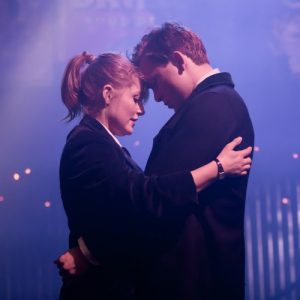
Molly Chesworth and George Parker in Teddy at The Vaults, London. Picture: Scott Rylander
Teddy continues at The Vaults, London until 3 June 2018.
Star rating: five stars ★ ★ ★ ★ ★
Contrasts and culture clashes lie at the heart of all the best dramas. And you can’t get much more of a contrast than the world of the 1950s Teddy Boy, as brought to life in Tristan Bernays and Dougal Irvine’s play with music, Teddy.
The phenomenon of the Teddy Boy itself is a whirl with contradictions: loving the American sound of rock‘n’roll, all raw in its electric guitars, checked shirts and leather jackets, but dressed up in Edwardian finery. The fashions were spurred on by a Savile Row revival, but fuelled by the easy availability of vintage clothes: this was an era from which the Teddies were apart by only 40 years. Four decades, and two world wars.
Bernays’ two central characters, Teddy and Josie, each have parents with their own demons. Like the bombed-out sites and deconsecrated churches in which their movement – teenagers before teenagers existed – the grown-ups are damaged, still to recover from who knows what fate the Second World War inflicted upon them.
Bernays’ script is structured largely as two monologue narrations from both George Parker’s Teddy and Molly Chesworth as Josie. Starting as parallel, similar tales of preparations for a night out, even when their paths cross we continue to see each character through the other’s description of them. It’s a highly theatrical conceit, of course, but this is another contrast: the sense of being drawn into these teenagers’ world by being reminded of the theatrical artifice.
That is a feeling that is further enhanced by Bernays’ use of rhyme. Parker and Chesworth’s delivery concentrates on emotion over meter, but the poetry shines through. It may be a literary technique that we might expect more on the boards of the Globe, but it enriches the story of two rebellious kids as they pursue their quest to get into a nightclub to witness their rock‘n’roll idol’s secret gig.
Said musician, Johnny Valentine, pops up in the form of actor Dylan Wood, performing a series of Irvine’s classic rock‘n’roll compositions accompanied by band the Broken Hearts (musical director Harrison White on guitar and piano, bassist Freya Parks and drummer Andrew Gallo).
While the music is largely non-diegetic, performed as accompaniment to Parker and Chesworth’s action, each band member has their own character, often providing moments of levity in contrast to the violence (both threatened and actual) pervading Teddy and Josie’s night.
But while there is a divide between the band and the actors, lines do get blurred: Parker has a brief sequence of singing as he imagines becoming the next Johnny Valentine, and his and Chesworth’s chemistry with each other infuses Tom Jackson Greaves’ breathtaking choreography during the nightclub scene.
Max Dorey’s set design, all corrugated sheeting and faded, curling advertisement hoardings, feels largely unchanged since this show’s previous London run at the Southwark Playhouse in 2015. However, framed within the artful shabbiness of The Vaults, it feels refreshed and an even better fit.
The environment is so well suited to Teddy that one almost does not notice the faint rumble of trains overhead. In a couple of moments, as action slows and tensions rise, the slow click-clack of carriage wheels rolling over points emit a low, thrumming heartbeat. It is a credit to Max Pappenheim’s sound design that, while one is almost entirely sure that the synchronicity of such sounds has been carefully crafted, one can never really be sure.
And that is the joy of Teddy. Everything about Eleanor Rhode’s production is as well-crafted as it possibly could be, resulting in an engrossing, entertaining theatrical production that brings to life an era of teenage exuberance and violence as it emerges from the rubble of post-war London. Long may it continue.
Scott Matthewman
SHARE THIS POST:


Comments are closed.