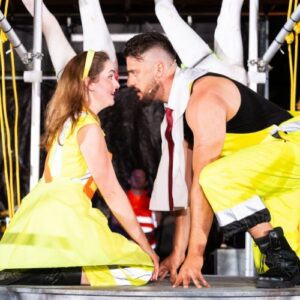
Picture: Elliott Franks
The Threepenny Opera continues at the Roman Theatre, St Albans until 6 September 2023.
Star rating: two stars ★ ★ ✩ ✩ ✩
Famously, The Threepenny Opera is a response to John Gay’s The Beggar’s Opera.
We’re in the corrupt, murky underworld of 1920s Berlin and Brecht is making a radical, no-holds-barred political comment. It’s timeless and I like the modern, sparky translation by Jeremy Sams and Robert David MacDonald very much.
This is the first open air production of The Threepenny Opera that the Kurt Weill Foundation has given permission for so I suppose there was a lot of pressure on OVO to make it special. That might explain the over direction, busy-ness and an apparent lack of trust in the material which isn’t really allowed to speak for itself until well into the second half.
Peter Watts as Macheath is the production’s greatest strength. He has commanding stage presence, a terrifying sneer, heaps of charisma and a powerful voice. He’s also deliciously “Brechtian”, stepping into the audience at one point to “steal” a phone from an audience member. Moreover, he brings intense physicality to the part and it’s clear we’re in Brecht territory. Of course, when he’s in role and within the fourth wall we’re meant to see him as an unscrupulous villain, but Watts also manages to factor some vulnerability and even tenderness into this serpentine character.
He is well matched by Emily Panes who sings beautifully as Polly Peachum, whom neither we nor Macheath can ever quite trust. She’s convincingly – and by turns – sassy, coy, persuasive and ruthless.
Otherwise there’s a lot of miscasting. Although some of the 15 performers sing well, others don’t and in places the weak intonation is embarrassing. Most of the cast are actor-musicians and normally I’m full of praise for that. In this case, though, everyone seems overstretched as they shift in and out of the three shelters which (sort of) sometimes house the band to take quite big roles. It feels oddly random.
And as for musical director Lada Valešová, who hops about and sometimes dances around the set and the actors, conducting from all sorts of strange angles – the music might have have been much more accurate and together if all the players had been able to see her.
Simon Nicholas’ set comprises a centre stage gasometer (or is it meant to be a bandstand?) which becomes various unlikely things such as the abattoir where Macheath “marries” Polly amidst a lot of stage business with parts of shop dummies as cuts of meat. It also obscures sightlines so that musicians can’t see the MD and, worse, so that many of the audience can’t see the action on the balcony or in corners of the main stage.
Yes, I know Brecht defied every convention and, in many ways, redefined theatre. The audience won’t be expecting Puccini. But they are still entitled to be able to see what’s going on – and they would probably rather not go home wondering what on earth Mattis Larsen’s apparently random lighting design was meant to contribute.
The applause, at the end of the performance I saw, was polite but far from rapturous. It’s a long show too (over two and a half hours) and it feels even longer.
Susan Elkin
SHARE THIS POST:




Comments are closed.