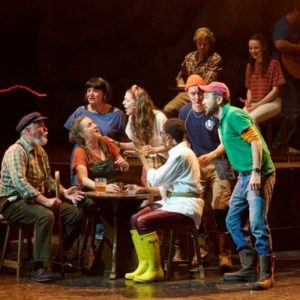
 The Stamping Ground continues at Eden Court, Inverness until 30 July 2022. A national tour is planned for 2023.
Star rating: four stars ★ ★ ★ ★ ✩
A musical based on music from Runrig, Scotland’s internationally famous band, has been hotly anticipated. Brothers Calum and Rory MacDonald, the founders of Runrig and the songwriting partnership, confessed that musical theatre was an unknown world and generously agreed that no fewer than 22 songs could become the base for The Stamping Ground.
Fused with Morna Young’s script and sensitive arrangements of the songs from John Kielty, there is a whole story that never seems to have to work hard to blend the songs with the characters and the plot. They all belong to each other and fit more neatly than many musicals created from scratch.
It’s a heatwave – appropriately enough, on the hottest day since records began. There are big themes here: climate change; depopulation from tourism; loss of older traditions, stories and wisdom; the diaspora of people in a very specific Scottish context; global capitalism; forgiveness and love. It is a loaded storyline – every character has a fully drawn history relating to this particular piece of land – “home”.
The cast is outstanding, working so well as an ensemble, knowing just when and how to bring their characters to the fore. The story is that of a family of three returning from London. Euan and Annie (Steven Miller and Neshla Caplan) were childhood sweethearts and had their daughter, Fiona, at just 16. Leaving London, after Fiona had been a victim of violent bullying, they return to find the community of Glenbeck is even smaller than it was when they left.
Summer (Christina Gordon) spends the peak of the tourist season working as a guide for visitors. Immediately likeable, her character serves as a narrator of sorts. The name, ‘Summer’, is a constant reminder of how the community has become reliant on tourism, yet at the same time struggles to keep a vibrant year-round community. With the local pub under threat of closure, the folk of the village band together to save the business from being sold. Annie finds herself quickly and fully involved in a fundraising festival, giving her the opportunity to shine with her glorious singing voice. The highland lilt catches the heart; the power in Caplan’s voice raises the hair on the back of the neck.
Runrig’s songs advance the story and characters perfectly from ‘Going Home’, through ‘The Cutter’ and ‘Somewhere’. The Gaelic songs and snatches of dialogue emphasise the changing identity of the Highlands and the importance of preserving the heritage and the very spirit of the place before it is lost forever. Fiona (Caitlin Forbes) is taken under the wing of her grandmother Mary (Annie Grace) and Summer, picking up some of the customs and language of the land.
Hearing the women’s voices, often in close harmony, suits the songs so well that it’s easy to forget that the music hasn’t been created for these characters. Further, the actors are also talented musicians, joining Keilty’s band that surrounds the performance space, picking up penny whistles, fiddle, cello, banjo as ‘guest’ instruments alongside a solid team on keyboards, drums and guitar. The variety is perfectly suited and of the highest order. Sublime…
Kenneth MacLeod’s design is magnificent. Based on circular forms, the raised central performance space is a giant circle, surrounded by varying heights that come and go as scenes change, beneath and before a massive circular Celtic wheel in a fractured state. A circular cyclorama surrounds the stage, holding the musicians in its embrace. The jagged lines that bisect the cyclorama are highlighted to great effect, working hand in glove with Simon Wilkinson’s lighting design. Pulsing like the vital signals of a patient under observation; blazing red like cracks in dried out soil and even depicting waves that chase each other around the circle in tune with the issues being played out in the space.
The ritualised movement sequences at the opening of each act serve as a focus, setting the tone for the scenes that will follow. Jade Adamson’s movement pieces elevate the everyday routines of the highlanders into that which becomes mythical, almost epic, in the way that the smallest parts of life are those that show the clear differences from one place to another.
Aside from the central theme of trying to save the village, Young also takes on several other issues: love is central in all of these sub-plots. The failing career of Euan as a writer and the reason for moving away in the first place, is not what it seems and he’s in conflict with his wife and his daughter – Annie trying to make time for herself again and stretch her wings; Fiona doing all she can to escape her father’s overly protective ‘hovering’. His mother striking up a new relationship with an old flame in a kind of Donna from Mamma Mia! romantic comedy line; an unsolved and unresolved murder plot’; the lack of homes for locals to be able to afford in an increasingly monetised world; the changing ownership of croft land – it’s a lot to deal with and Luke Kernaghan’s direction keeps a flow and pace that helps any sudden shifts in performance register and overall mood.
Although Act II does falter now and then, the curtain finale of ‘Loch Lomond’ has the whole theatre on its feet in a ceilidh-like atmosphere that leaves everyone joyous and satisfied.
A magnificent evening, a co-presentation from Eden Court and Raw Material, that will tour the country next year and looks certain to appeal to the diaspora, particularly Canada with its strong ties to Runrig. A celebration of the love of the land – Scotland.
Fiona Orr
SHARE THIS POST:


Comments are closed.