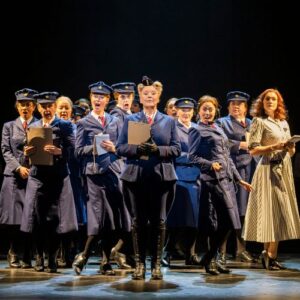
Isabelle Peters, Susan Bickley, Heather Lowe and cast in The Yeomen of the Guard at the London Coliseum. Picture: Tristram Kenton
The Yeomen of the Guard continues at the London Coliseum until 2 December 2022.
Star rating: three stars ★ ★ ★ ✩ ✩
Gilbert and Sullivan’s darkest opera, first staged in 1888, is about a man condemned to death in the Tower of London. A last minute rescue leads to disguise, much obfuscation and, ultimately, three pretty iffy marriages and one broken heart.
And along the way much of the music is Sullivan at his finest. The Act I finale – beautifully staged here by Jo Davies, working up to the climactic point when they discover that the cell is empty – is as good as anything written by ‘serious’ opera composers such as Verdi.
There’s much to admire in this gently updated revival. We’re in 1953 and it works rather well although I would rather not have filmed news footage – clever as the concept is – obliterating the sound of Sullivan’s finest overture being beautifully played by a full sized pit orchestra under Chris Hopkins’ baton.
Everything about this production is grandiloquent. An immaculately choreographed (Kay Shepherd) ensemble of 50 people is directed to use every inch of ENO’s huge playing space.
We first see the titular Yeomen in their wardroom in their vests with cups of tea gradually singing their way into their familiar, elaborate uniforms – and that’s one of this show’s many good ideas. The use of the revolve is another – especially for the construction of a scaffold at the end of Act 1.
The concept of the female chorus as Women’s Royal Army Corps with Dame Carruthers (Susan Bickley – good) as their commanding officer fits the bill perfectly. And the trio of tap dancing guardsmen in their busbies are an unexpected, joyfully absurd delight.
Anthony Ward’s sets take evocative ownership of the space, ultimately including a miniature Tower on the revolve which provides an encircling shelf on which some scenes are staged at a slightly higher level.
Fairfax is not, it has to be said, the most likeable of characters, but Anthony Gregory gives one of the finest performances of the show in this role. His tenor voice has a golden mellifluousness to it especially in ‘Free from his fetters grim’ in Act II.
I liked John Molloy’s head jailer Shadbolt too. He’s a tall, lithe man and a nippy dancer which, along with his rich bass voice, makes the character more human and less grotesque than sometimes.
Heather Lowe, a pleasing soprano, packs Phoebe, a young woman whose father works in the Tower, with pertness and feeling. She performs ‘Were I thy bride’ for example with lots of musical humour.
Alexander Oomens, meanwhile, sings with tuneful passion and total conviction as the hapless Elsie Maynard – manipulated by almost every man in the show.
However Richard McCabe as Jack Point, the travelling jester is a disappointment. This colourful tragic fool who loses his sweetheart to Fairfax should be the star of The Yeomen of the Guard. In this production he isn’t.
McCabe is an excellent, justifiably famous actor but he’s woefully miscast here. He isn’t a singer and that sticks out tellingly if you put him on stage with a whole cast of trained opera singers. He is often out of tune. He struggles to make some of the sung diction clear and in duets and quartets his voice tends to dip when others are singing with him. Moreover he often drags the tempo.
Even his mincing about posturing as a weary 1950s comedian doesn’t quite cut the mustard. He does the last scene well though – drunk, staggering with braces hanging down. It’s another of the show’s good ideas.
This production – for all its interesting ideas – moves ploddingly slowly. Two hours and 40 minutes (including interval) is a long haul by G&S standards.
Some music which is usually cut has been restored and the dialogue is often so sluggish that it’s almost declamatory. Then, Instead of ‘Rapture, rapture’ we get, amusingly, ‘My eyes are fully open’ from Ruddigore and that says it all. “This particularly rapid, unintelligible patter” is neither rapid nor unintelligible as sung here. In fact it’s rather pedestrian and that goes for other moments in the show too.
Perhaps it’s giving this relatively serious piece the ‘grand opera’ treatment which Sullivan always aspired to but, dramatically, it needs to move faster than it does in this version.
Susan Elkin
SHARE THIS POST:


Comments are closed.